
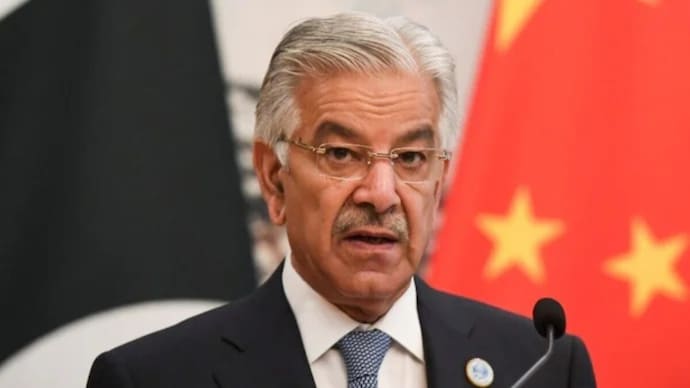
In a fresh escalation of tensions in South Asia, Pakistan’s Defence Minister Khawaja Asif issued a stern warning to both India and Afghanistan, declaring that Islamabad would “pay back in the same coin” following a series of deadly terror attacks that have rocked the country in recent days. The warning comes amid growing instability and renewed concerns over cross-border terrorism, regional security, and internal extremism in Pakistan.
Twin Attacks Spark Outrage in Pakistan
Over the last 48 hours, Pakistan has witnessed two major terrorist incidents that have left the nation in shock. The first attack targeted Cadet College Wana, located in the volatile region of South Waziristan, killing several soldiers and students. The second explosion occurred in the heart of Islamabad, near the city’s court complex, where at least 12 people were killed and over 20 injured. Initial reports suggest the explosion might have been caused by a gas cylinder fitted inside a parked vehicle, though investigators have not ruled out the involvement of extremist groups.
The near-simultaneous nature of these attacks has raised alarms across Pakistan’s security establishment. The Defence Minister, visibly angered during a press briefing, accused “foreign hands” of destabilizing Pakistan and hinted at potential involvement from neighboring countries.
Khawaja Asif’s Strong Words
Addressing a press conference in Islamabad, Khawaja Asif said,
“Pakistan is not weak. Those who think they can inflict harm upon us will receive a fitting response. Whether it is India or Afghanistan, Pakistan will pay back in the same coin.”
The minister’s comments have stirred strong reactions both domestically and internationally. His statement reflects a familiar tone used in Pakistan’s security discourse, especially when the country faces internal attacks or external pressure. The government has promised a full-scale investigation and a military-led crackdown on the groups responsible.
bizkeyaccess.com | acebizpro.com | zipbizhub.com
biz-connector.com | primebizworld.com
India, Afghanistan Blamed Again
Pakistan’s political leadership has often accused India and Afghanistan of supporting anti-Pakistan militant groups operating near the borders. Islamabad claims that Indian intelligence agencies have ties with groups like the Tehrik-i-Taliban Pakistan (TTP), which frequently launches attacks from Afghan soil. However, both India and Afghanistan have repeatedly denied such allegations, calling them “baseless” and “politically motivated.”
In this instance, while Asif stopped short of naming a specific organization, sources within Pakistan’s interior ministry indicated that early evidence points toward TTP’s involvement, a group that has resurged since the Taliban’s return to power in Kabul in 2021.
Rising Insecurity Along Afghan Border
Pakistan’s western frontier with Afghanistan has remained volatile for years, but tensions have deepened since the Taliban’s takeover. Islamabad had initially welcomed the Taliban regime, expecting greater cooperation in containing cross-border militancy. Instead, the TTP has gained strength, using Afghan territory as a base to plan and execute attacks inside Pakistan.
According to Pakistan’s Inter-Services Public Relations (ISPR), over 400 Pakistani security personnel have been killed in militant attacks in 2025 alone. The country’s intelligence agencies have repeatedly shared dossiers with Kabul, urging action against TTP hideouts. However, Afghan authorities have largely dismissed these concerns, insisting that Afghanistan’s soil is not being used for terrorism.
India-Pakistan Angle: A Cycle of Accusations
While relations between India and Pakistan remain frozen since the revocation of Article 370 in Jammu & Kashmir, incidents like these tend to inflame rhetoric on both sides. Indian officials have not commented officially on Asif’s latest warning, but New Delhi has consistently argued that Pakistan’s “internal instability” is the result of its own policies of nurturing militancy.
Defence analysts in India have also pointed out that such statements from Islamabad often emerge when domestic political pressures mount or when the military seeks to divert public attention from internal failures.
Meanwhile, Pakistani media outlets have amplified Asif’s statement, portraying it as a sign of national resolve. Several talk shows have demanded “decisive action” against hostile elements, even suggesting that Pakistan “reconsider its diplomatic approach” toward both neighbors.
Internal Challenges for Islamabad
Beyond the external blame game, Pakistan continues to face serious internal challenges. Economic instability, rising inflation, and political infighting have created fertile ground for extremist propaganda. The government, led by Prime Minister Shehbaz Sharif, has been struggling to maintain order amid growing discontent over governance and security lapses.
Security experts warn that militant groups are exploiting this environment to stage attacks in major cities. The Islamabad blast, in particular, has highlighted the vulnerability of urban centers, with many questioning how such a device could be planted in a heavily guarded zone.
A senior police official speaking on condition of anonymity admitted,
“Security protocols were ignored. We were focused on rural counter-terrorism operations while the attackers struck the capital.”
Regional Fallout and Global Response
The international community has expressed concern over the renewed violence in Pakistan. The United Nations, through its regional office, condemned the attacks and urged restraint among neighboring nations. The U.S. State Department called for “greater regional cooperation” to combat terrorism, emphasizing that “retaliation rhetoric” would only fuel instability.
China, a key ally of Pakistan, also issued a statement offering support for Pakistan’s counter-terrorism measures while subtly urging dialogue with neighboring countries to prevent escalation.
Military Readiness and Future Scenarios
Pakistan’s military has reportedly placed its border units on high alert, particularly along the Line of Control (LoC) and the Durand Line. The armed forces have launched search operations in several districts of Khyber Pakhtunkhwa and Balochistan, targeting suspected TTP and ISIS cells.
Analysts believe that Pakistan might use this moment to intensify its diplomatic offensive against both India and Afghanistan, seeking international recognition for its security concerns. However, critics argue that unless Pakistan addresses its internal radicalization and reforms its counter-terror policies, such cycles of violence and blame will continue.
Conclusion
The recent terror attacks in Islamabad and South Waziristan have once again exposed the fragility of Pakistan’s security structure. Defence Minister Khawaja Asif’s fiery remarks may resonate with domestic audiences, but they risk worsening relations with India and Afghanistan — two neighbors with whom Pakistan already shares deep mistrust.
Experts suggest that instead of engaging in rhetorical escalation, Pakistan must focus on intelligence coordination, cross-border diplomacy, and internal reforms to counter terrorism effectively. As regional fault lines sharpen, the coming weeks will determine whether Islamabad opts for confrontation or cooperation in ensuring lasting peace.